
To clear cloudy pool water, you’ll need to test and balance your pH (7.2-7.6), chlorine (1-3 ppm), and alkalinity (80-120 ppm) levels using fresh test strips. Run your filtration system 8-12 hours daily and clean or backwash filters when pressure rises 8-10 PSI. Add a pool clarifier (1oz/5000gal) to coagulate particles, then vacuum debris. For stubborn cloudiness, shock treat with 1lb/10000gal while maintaining proper circulation. Understanding each treatment step guarantees lasting clarity.
Key Takeaways
- Test water chemistry for pH (7.2-7.6), chlorine (1-3 ppm), and alkalinity (80-120 ppm) using fresh testing strips or digital meters.
- Run the pool filter 8-12 hours daily and backwash when pressure increases 8-10 PSI above normal operating level.
- Add pool clarifier to coagulate particles (1oz/5000gal) or flocculant to sink debris (2oz/10000gal) while maintaining circulation.
- Shock treat the pool with chlorine (1lb/10000gal) to oxidize contaminants and eliminate organic matter causing cloudiness.
- Clean skimmer baskets, pump strainers, and filters regularly while brushing pool walls weekly to prevent particle accumulation.
Understanding the Main Causes of Cloudy Pool Water
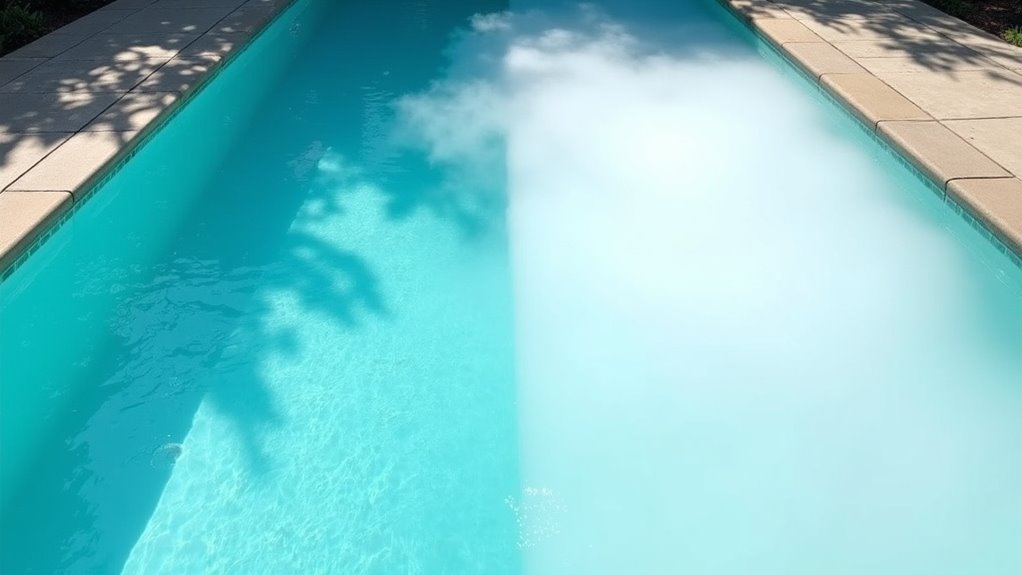
Although cloudy pool water can be frustrating, identifying its root cause is essential for effective treatment. Your pool’s cloudiness typically stems from four primary sources: chemical imbalances, inadequate water circulation, environmental factors, and high bather load.
Chemical imbalances occur when pH, chlorine, or alkalinity levels aren’t within proper ranges, leading to ineffective sanitization. Poor water circulation prevents your filter from removing contaminants efficiently, resulting in particle accumulation throughout the pool. Environmental factors like pollen, dust, and debris can overwhelm your filtration system, while heavy pool usage introduces oils, lotions, and organic matter that cloud the water.
You’ll need to test your water parameters and inspect your filtration system to determine which of these factors is causing your specific issue before implementing the appropriate solution.
Essential Pool Water Testing and Analysis
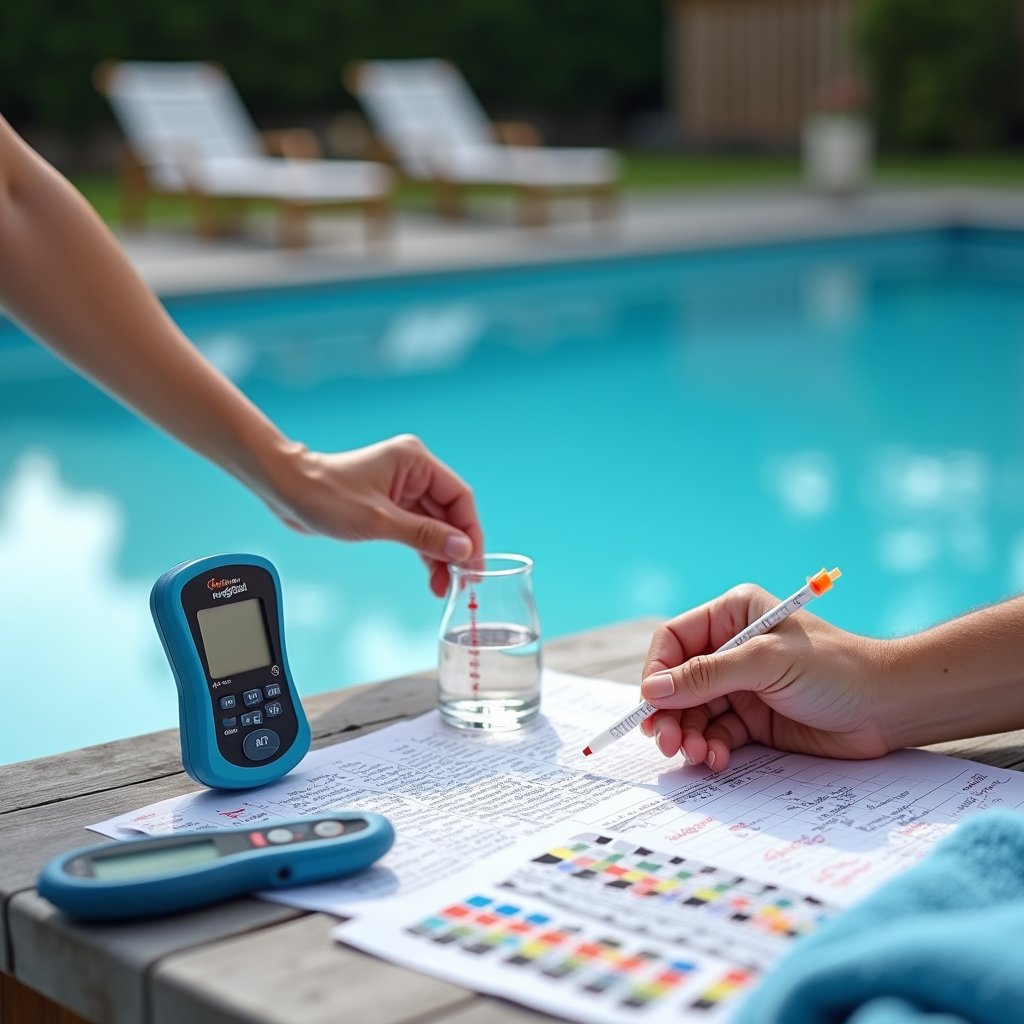
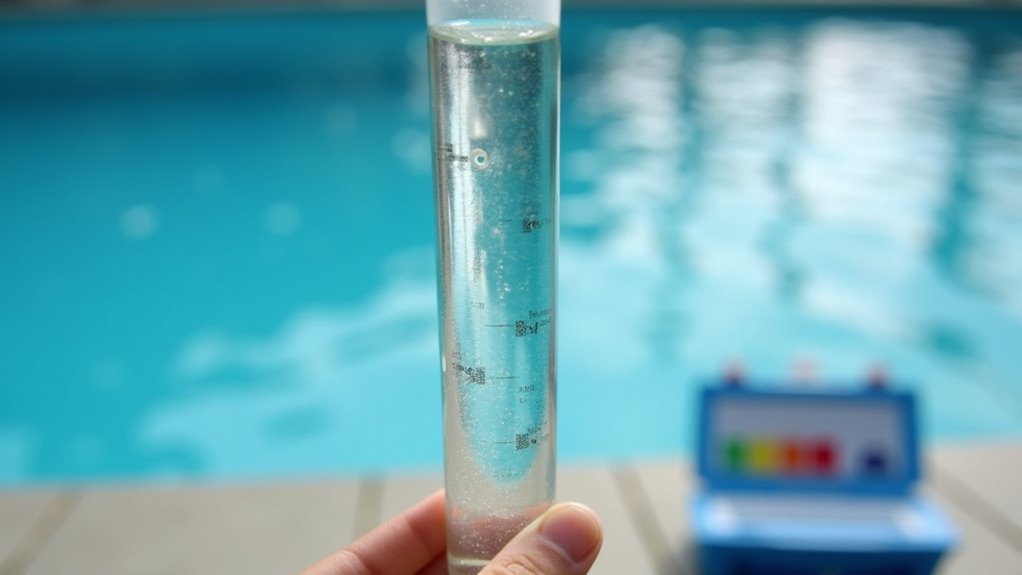
Three essential water parameters must be tested regularly to diagnose cloudy pool water: pH level, free chlorine concentration, and total alkalinity. You’ll need to collect a water sample from elbow-depth, away from return jets and skimmers, to get accurate readings.
Test your pool water at least 2-3 times per week, increasing testing frequency during heavy use or after rain. The ideal pH range is 7.2-7.6, free chlorine should be 1-3 ppm, and total alkalinity should measure 80-120 ppm. Use fresh testing strips or a digital meter for reliable results, as expired testing materials can give false readings. Additionally, Understanding pool water chemistry is key to a safe, algae-free pool. Keep stabilizer levels between 30–50 ppm to support chlorine effectiveness, and adjust chemicals as needed for proper balance.Ask ChatGPT
If any parameters fall outside these ranges, you’ll need to adjust them systematically, starting with total alkalinity, then pH, and ultimately chlorine levels.
Balancing Pool Chemistry Levels
Once you’ve identified imbalanced water parameters through testing, correcting them requires a systematic approach that prioritizes safety and proper chemical sequencing. Start by adjusting total alkalinity levels initially, as this helps stabilize pH balance. Target a range of 80-120 ppm for alkalinity.
After achieving proper alkalinity, focus on pH balance, aiming for 7.2-7.6. Add pH increaser if your levels are too low, or pH decreaser if they’re too high. Wait at least six hours between chemical adjustments to allow for proper circulation and accurate readings.
Remember to wear appropriate safety gear when handling pool chemicals, including protective eyewear and chemical-resistant gloves. Never mix different chemicals together, and always add chemicals to water, not water to chemicals.
Proper Filtration System Maintenance
Proper chemical balance works hand-in-hand with an efficiently operating filtration system. To maintain peak pump efficiency, you’ll need to monitor your filter’s pressure gauge daily. When the pressure rises 8-10 PSI above normal, it’s time to backwash your filter.
Clean or replace your filter cartridges according to manufacturer specifications. For sand filters, backwash when needed and replace the media every 5-7 years. DE filters require regular backwashing and annual grid cleaning. Keep your pump basket free of debris and maintain appropriate water levels to prevent air from entering the system.
Check your pump’s seals and o-rings regularly for wear. Listen for unusual noises that might indicate bearing issues. Addressing mechanical problems promptly will extend your equipment’s life and maintain peak filtration performance.
Shock Treatment Methods and Best Practices
Shocking your pool requires careful attention to both timing and chemical dosage to effectively eliminate contaminants and restore water clarity. For best results, perform shock treatments during evening hours when UV exposure won’t interfere with the treatment duration. You’ll need to maintain proper shock frequency based on pool usage and environmental factors.
- Add 1 pound of pool shock per 10,000 gallons of water, increasing the dose to 2 pounds for severe clouding or after heavy rainfall.
- Keep your pool’s filtration system running for at least 6 hours after shocking to guarantee proper chemical distribution.
- Wait until chlorine levels return to 1-3 ppm before swimming, typically 24-48 hours post-treatment.
Always test your water before shocking and wear appropriate safety gear when handling pool chemicals. Don’t shock during windy conditions or combine different types of shock treatments.
Dealing With Algae Growth and Prevention
Regular shock treatments help prevent algae, but when these microscopic organisms take hold, you’ll need a targeted approach for elimination. Different algae types require specific treatments and prevention strategies.
| Algae Type | Appearance | Treatment Method |
|---|---|---|
| Green | Cloudy, green water | Brush walls, shock with chlorine |
| Black | Dark spots on walls | Algaecide + vigorous brushing |
| Yellow/Mustard | Powdery brown patches | Specialized algaecide, pH adjustment |
| Pink | Slimy pink film | Non-metallic algaecide + sanitizer |
To prevent future algae growth, maintain proper chemical balance, run your filter continuously, and brush pool surfaces weekly. Test water chemistry daily during active algae treatment. Don’t hesitate to use preventive algaecide when conditions favor algae growth, such as during warm weather or after heavy rain.
Environmental Factors Affecting Pool Clarity
While maintaining proper chemical levels is essential, different environmental factors can greatly impact your pool’s clarity regardless of your maintenance routine. Understanding these external influences helps you adapt your pool care strategy and maintain crystal-clear water throughout changing conditions.
- Extended sunlight exposure accelerates chlorine degradation and promotes algae growth, requiring you to maintain higher sanitizer levels during sunny periods and consider using chlorine stabilizers
- Wind effects can blow debris, dirt, and pollutants into your pool, while also increasing water evaporation rates which concentrates dissolved solids and minerals
- Heavy rainfall dilutes your pool’s chemical balance and introduces organic contaminants, phosphates, and nitrates that can lead to cloudy water and create favorable conditions for algae growth
You’ll need to adjust your maintenance schedule based on these environmental factors for best results.
Chemical Solutions and Treatment Options
Several proven chemical treatments can effectively clear cloudy pool water when properly applied. You’ll need to carefully select and dose the right chemical additives based on your water test results. Treatment techniques include using pool clarifiers to clump tiny particles, flocculants to sink debris, and shock treatments to eliminate organic contaminants.
| Treatment | Purpose | Dosage Rate |
|---|---|---|
| Clarifier | Coagulates particles | 1oz/5000gal |
| Flocculant | Sinks debris | 2oz/10000gal |
| Shock | Oxidizes contaminants | 1lb/10000gal |
| pH Plus | Raises pH | 4oz/10000gal |
| pH Minus | Lowers pH | 3oz/10000gal |
Always test your water before adding chemicals and maintain proper circulation during treatment. Remember to wait the recommended time between applying different chemical additives to prevent unwanted reactions that could worsen cloudiness.
Pool Maintenance Schedule for Crystal Clear Water
A consistent maintenance schedule forms the foundation of crystal clear pool water. You’ll need to establish a routine that includes daily, weekly, and monthly tasks to prevent cloudy water issues before they develop. Regular pool cleaning and proper water circulation work together to maintain ideal conditions.
- Daily Tasks: Run your pump 8-12 hours, check chlorine levels, empty skimmer baskets, and monitor water level
- Weekly Tasks: Test complete water chemistry (pH, alkalinity, stabilizer), brush walls and floor, vacuum debris, backwash filter, and shock treat water
- Monthly Tasks: Deep clean filter system, inspect equipment for leaks or damage, test total dissolved solids (TDS), and add preventive algaecide
Following this schedule helps maintain water clarity while preventing the buildup of contaminants that cause cloudiness. Adjust maintenance frequency based on pool usage and environmental conditions.
Preventing Future Cloudy Water Issues
Maintaining your pool’s clarity long-term requires preventive strategies beyond regular maintenance schedules. You’ll need to establish a proactive approach that combines proper circulation with consistent chemical monitoring. Regular water testing helps catch issues early. Avoid common pool maintenance errors like dirty filters or excessive chemicals to keep your pool clear, safe, and inviting year-round.
Install a pool timer to guarantee your pump runs at least 8-12 hours daily, promoting ideal water movement and filtration. Conduct regular cleaning of skimmer baskets, pump strainers, and filter systems to prevent debris accumulation that can lead to cloudy conditions. Test your water chemistry daily, adjusting pH levels between 7.2-7.6 and maintaining free chlorine at 1-3 ppm.
Don’t wait for visible issues before taking action. Brush pool walls weekly, vacuum thoroughly, and backwash your filter when pressure rises 8-10 PSI above normal. These preventive measures will help maintain crystal-clear water and reduce the likelihood of future cloudiness.
Frequently Asked Questions
Can I Swim in a Cloudy Pool While Chemicals Are Being Added?
You shouldn’t swim in a pool while chemicals are being added or when the water’s cloudy, as this poses serious safety risks. Cloud safety guidelines recommend waiting until chemicals are fully dissolved and distributed, typically 4-24 hours depending on the treatment. Swimming limits should be strictly observed – if you can’t see the bottom of the pool clearly, don’t enter. Chemical imbalances can cause skin irritation, respiratory issues, and impaired visibility underwater.
How Long Should I Wait After Shocking Before Retesting Pool Water?
You’ll need to wait at least 4-6 hours after shocking your pool before retesting the water chemistry. For best accuracy, it’s recommended to wait 24 hours to allow the shock treatment to fully circulate and dissolve. During this waiting period, monitor your water clarity as a visual indicator. If you’re using chlorine-based shock, test the free chlorine levels initially to verify they’ve returned to safe swimming ranges (1-3 ppm).
Will Running My Pool Vacuum Help Clear up Cloudy Water Faster?
Yes, running your pool vacuum will help clear cloudy water faster as part of effective pool maintenance. Your vacuum removes debris and particles that contribute to cloudiness, while also improving water circulation. For maximum vacuum efficiency, make sure you’re using the “filter” setting, not “waste.” Keep in mind that vacuuming alone won’t solve chemical imbalances, so you’ll still need proper water chemistry to achieve crystal-clear results.
Does Rain Make Pool Water Cloudy Even With Proper Chemical Levels?
Yes, rain can make your pool cloudy even with balanced chemicals. Rain’s impact disrupts your water chemistry by diluting existing chemicals and introducing contaminants like dust, pollen, and nitrogen. You’ll often notice cloudiness after rainfall because rainwater’s pH (5.6-6.0) differs from your pool’s ideal pH (7.2-7.6). Don’t worry – this is normal, but you’ll need to test and adjust your chemicals after significant rainfall to restore clarity.
Can Using the Wrong Type of Chlorine Cause Long-Term Cloudiness Issues?
Yes, using the wrong chlorine types can definitely cause persistent cloudiness issues in your pool. If you’re using a stabilized chlorine when your cyanuric acid levels are already high, you’ll create over-stabilization, making it harder for the chlorine to work effectively. Likewise, if you’re using calcium hypochlorite in hard water, you’ll contribute to calcium buildup. To avoid these cloudiness causes, always match your chlorine type to your pool’s specific chemistry needs.