


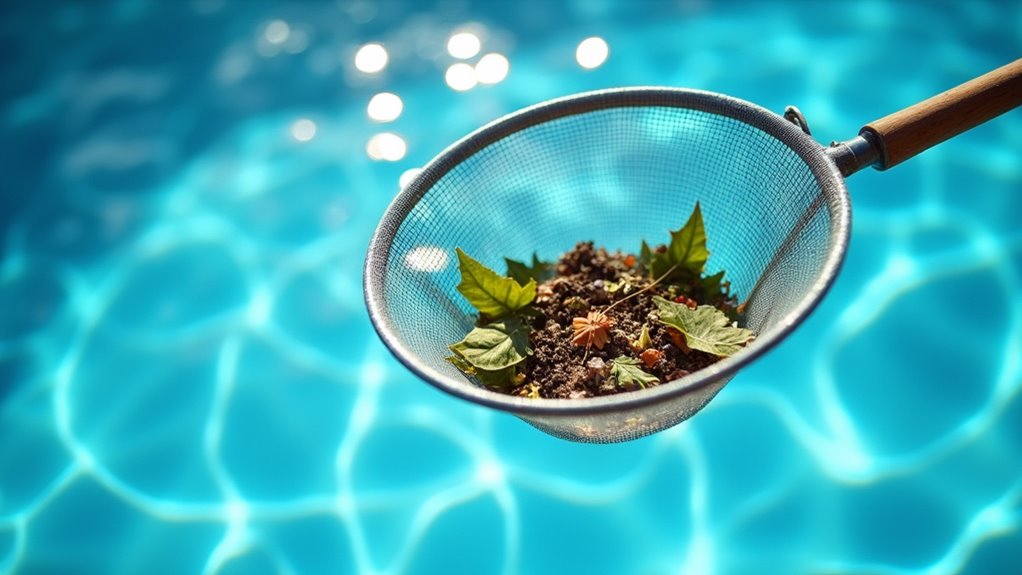

Your pool filter traps debris through layered mechanical processes working in concert. Water enters through the skimmer, then the pump pressurizes it into your filter tank where media, sand, cartridge, or DE captures particles based on size. Pressure differentials force debris against filter surfaces, while deeper beds intercept progressively smaller particles through straining, interception, and diffusion. Angular media granules and surface roughness create friction points that lodge contaminants. Understanding these mechanisms reveals why systematic pressure monitoring and timely maintenance prove essential.
The Journey: Water Entry and Initial Filtration
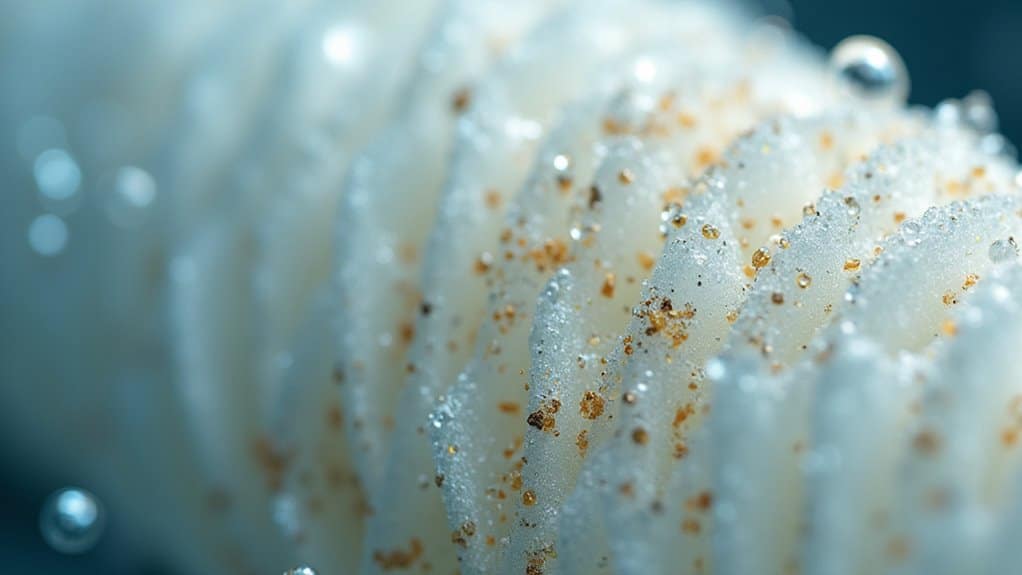
Every pool’s filtration system starts at the surface, where a skimmer collects floating debris before it can sink and complicate downstream filtration. The skimmer’s floating weir prevents collected debris from flowing back into your pool while its basket physically traps larger contaminants.
Once water enters the pump, suction pulls it through a strainer pot, your system’s second defense. This pre-filtration stage catches medium-sized particles, protecting your pump from damage and blockages.
The pump’s impeller then pressurizes the water, forcing it into your filter tank where internal baffles enable even water distribution. Maintaining a suitable flow rate is critical; it slows water sufficiently to maximize contact with filter media while preventing channeling. For public pools, a medium filtration rate of 10-25 m3/m2/hr is recommended to ensure optimal clarity and contaminant removal. Different filter types like sand, cartridge, and DE filters each use specialized media designed to capture particles of varying sizes as water passes through. Sand acts as a natural cleaning crew to trap dirt, leaves, dead insects, and other small particles effectively. This controlled entry guarantees thorough debris capture from the filtration process’s very beginning.
Filter Media Types and Their Particle-Capturing Capabilities
You’ll find that different filter media types capture debris at remarkably different scales, ranging from sand’s 20-micron capability down to DE and cellulose fiber’s 2-micron precision. Your choice of media directly impacts filtration efficiency; glass and zeolite media outperform standard sand by capturing finer particles through advanced structural properties, while cartridge systems offer flexibility with options reaching down to 2–5 microns when improved. Understanding these performance differences helps you select the right media for your pool’s specific contamination profile and maintenance requirements. Filter glass media provides longer lifespans of 10-15 years compared to traditional sand filters, making it a more durable investment for pool owners. Diatomaceous earth filters are particularly noteworthy because they can trap particles down to 3-5 microns, providing superior clarity compared to sand and cartridge alternatives.
Particle Size Capture Ranges
Different filter media types don’t capture debris uniformly; they’re engineered with distinct pore structures that determine which particle sizes they’ll trap. Sand filters capture debris in the 20–40 µm range, effectively removing large contaminants like hair and pollen. Cartridge filters perform better, trapping particles at 8–30 µm through their pleated design, which increases surface area for fines retention. DE filters excel with 1–3 µm capture rates, using microscopic diatom shells to trap bacteria-sized particles. Particle shape considerations and composition effects influence actual retention; irregular particles may lodge differently than spherical ones, while organic versus inorganic materials respond distinctly to each media type. Real-world performance varies based on flow rate, filter loading, and maintenance consistency, with D.E. filters resolving adverse water conditions more quickly than sand or cartridge alternatives. Direct interception and inertial impaction work together to capture particles as they navigate through the filter matrix, ensuring contaminants cannot follow their original fluid streamlines.
Media Type Performance Differences
While sand filters establish the baseline for pool filtration, alternative filter media have emerged that vastly outperform traditional silica in both particle capture and operational efficiency. Zeolite delivers 90% greater efficiency and reduces media regeneration cycles extensively through lighter density. Glass media filters particles to 3–5 microns with superior resistance to channeling, minimizing water bypass. FilterBalls handle 20 times more debris than sand, dramatically reducing backwash frequency. Diatomaceous earth achieves the finest clarity at 3–5 microns but demands manual replacement. Cellulose fiber matches DE performance at 2-micron capture while offering biodegradability and reduced bridging. Mechanical filtration media should be cleaned regularly to prevent clogging and maintain water flow for optimal performance. A strand of human hair measures approximately 70 microns wide, providing a useful reference point for understanding the relative effectiveness of different filter media types. Each media type’s mechanical trapping capabilities differ enormously; your selection depends on balancing particle size requirements against maintenance demands and long-term operational costs.
How the Mechanical Trapping Process Works
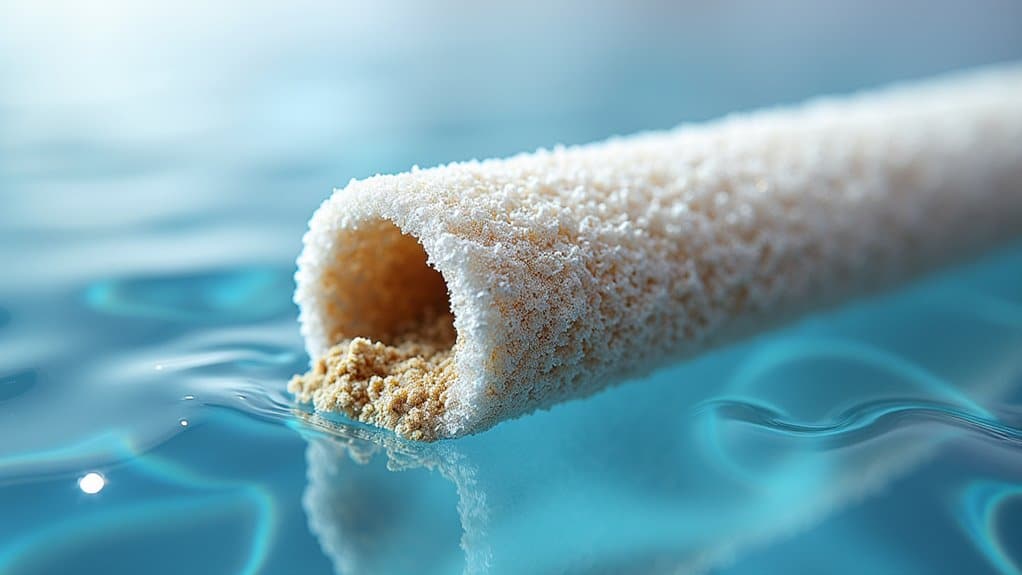
When you push water through your filter media under pump pressure, you’re creating the force needed to capture particles of varying sizes. The density and composition of your chosen media, whether sand, cartridge pleats, or diatomaceous earth grids, determines which debris gets trapped and which passes through. Deeper filter beds give smaller particles more opportunities to be caught, while shallower or less dense media allow finer contaminants to slip past. Skimmers prevent clogged filters by removing large debris from the pool’s surface before it ever reaches your filtration system, working in tandem with the filter media to ensure optimal water clarity and circulation.
Pressure Forces Particle Capture
Your pool filter’s mechanical trapping process begins the moment the pump pressurizes water and forces it through the filter medium. This pressure differential creates distinct flow patterns that push debris against filter surfaces, where surface effects reinforce particle retention.
The pressure-driven capture mechanism operates through several key actions:
- Pressure forces wedge particles at pore openings, immobilizing them through axial fluid pressure
- Flow patterns direct particles toward retention sites while pressure differential intensifies mechanical capture
- Surface effects create friction between debris and filter walls, preventing displacement
- Increasing pressure drop signals rising particle accumulation and reinforced retention efficacy
- Higher water pressure accelerates particle movement to capture zones, improving velocity-dependent interception
As clogging progresses, your filter’s pressure gauge reflects mounting resistance, confirming debris entrapment and system performance degradation requiring maintenance intervention. The interception effect causes particles flowing near filter fibers to contact and adhere to surfaces, enhancing the overall mechanical trapping efficiency of your pool filtration system.
Media Density Traps Debris
Because filter media density directly determines how effectively particles are intercepted and retained, understanding this relationship proves essential to optimizing your pool’s filtration performance. Higher media density compresses interstitial spaces, creating smaller gaps that trap finer particulates you’d otherwise miss. You’ll notice that denser media correlates with improved removal of colloidal matter, though you must balance density against flow resistance to prevent premature clogging.
Media surface texture amplifies density’s trapping capability. Rougher surfaces increase mechanical interception points, enhancing debris capture efficiency. Angular granules like silica sand provide superior surface area compared to rounded alternatives, creating more microscopic crevices where particles lodge. Harder media creates more electrostatic charge, which draws dirt particles to the surface in addition to mechanical trapping. Standard silica sand effectively filters particles down to 20 microns, making it an excellent choice for residential pool applications. Your media density effects directly influence how quickly head loss accumulates; denser configurations demand more frequent backwashing but deliver superior clarity and remove particles as small as 20-40 microns in standard sand filters.
Depth Determines Particle Size
Filter bed depth fundamentally controls which particle sizes you’ll capture at different stages of the filtration process. As water descends through layered media configurations, you encounter progressively narrower pores that systematically remove increasingly smaller particles. Particle density gradients develop naturally, with larger debris trapped near the surface and fine particles, below 10 microns, captured in lower sections.
Your filter bed’s depth directly determines filtration efficiency:
- Surface layers trap large debris through straining and inertial impaction
- Mid-depth zones capture medium particles via interception mechanisms
- Lower sections remove fine particles through diffusion and Brownian motion
- Bridging effects strengthen in deeper beds with multiple irregular particles
- Conventional 15–30 inch depths optimize multi-stage particle removal
Deeper beds penetrate suspended solids further before clogging, extending filter life extensively.
Understanding Flow Dynamics and Pressure Changes
As water moves through your pool’s filtration system, the relationship between flow rate and pressure fundamentally determines how effectively debris gets trapped. You’ll notice pressure increases proportionally with debris accumulation, indicated by PSI readings on your gauge. A clean filter typically exhibits baseline pressure; rises of 8–10 PSI signal significant debris buildup requiring maintenance.
Flow rate correlates directly with the square root of pressure differential across filter media. Higher pressure doesn’t guarantee better trapping; excessively high flow forces small particles through, reducing efficiency. Backflow prevention mechanisms protect against reversed flow during cleaning cycles.
| Condition | PSI Range | Action Required |
|---|---|---|
| Clean filter | Baseline | Monitor |
| Moderate debris | +5–8 PSI | Plan cleaning |
| Heavy debris | +10+ PSI | Backwash immediately |
You’ll optimize filtration by maintaining electrical conductivity in pool water alongside balanced pressure dynamics.
The Science Behind Different Filtration Grades
Your pool’s pressure dynamics only tell part of the filtration story; the actual mechanics of debris capture depend on what you’re filtering with. Different media types excel at trapping particles of varying sizes, fundamentally affecting your water quality and bather experience.
Consider these filtration performance levels:
- Sand filters capture 20–40 microns; adequate for visible debris but miss fine contaminants
- Cartridge filters trap 10–20 microns; considerably more effective than sand
- Glass and zeolite media achieve 2–5 micron performance; excel at irritant capture performance
- AFM® technology removes 95% down to 1 micron; superior clarity and chemical reduction benefits
- D.E. filters deliver finest filtration; microscopic contaminant removal through specialized grid coating
Finer filtration grades reduce cloudiness, limit algae and bacterial growth, and decrease pathogen circulation. Advanced media also minimize chloramine formation, enhancing swimmer comfort while safeguarding equipment from abrasive recirculation.
Backwashing and Cleaning: Restoring Filter Efficiency
Once pressure accumulates and debris saturates your media, you’ll need to reverse the filtration cycle to restore efficiency. Backwashing forces water backward through your filter, expelling trapped contaminants through a waste hose until discharge water runs clear, typically 2–5 minutes.
| Filter Type | Backwash Process | Post-Backwash Step |
|---|---|---|
| Sand | Set valve to “Backwash,” run pump | Set to “Rinse” 1–2 minutes |
| DE | Set valve to “Backwash,” run pump | Add fresh DE powder |
| Cartridge | Remove cartridges manually | Rinse and reinstall |
Your filter performance monitoring should track pressure gauge readings 8–10 psi above baseline. Regular filter inspection techniques, examining backwash water clarity and checking flow rates, signal when cleaning’s needed every 4–6 weeks. Proper maintenance prevents clogging, extends lifespan, and maintains water clarity and safety.
Long-Term Maintenance and Media Replacement Schedules
While backwashing restores temporary filter efficiency, you’ll eventually need to replace your filter media entirely, a critical step that determines your pool’s long-term filtration performance. Your filter selection criteria and maintenance recordkeeping directly influence replacement intervals. Monitor pressure gauges and water clarity metrics to anticipate media degradation before performance declines.
Proactive pressure monitoring and water clarity assessment help anticipate filter media degradation before performance suffers.
Key replacement indicators:
- Cartridge filters: visible tears, crushed pleats, persistent high pressure after cleaning
- Sand media: clumping, calcification, channeling, or inefficient debris capture
- DE grids: tears, breakage, inability to trap fine particles
- All types: recurring algae blooms or water quality issues
- Performance metrics: pressure remaining heightened post-cleaning despite proper technique
Typical intervals vary: cartridge filters (2–3 years), sand media (3–5 years), DE grids (7–10 years). Heavy usage, seasonal debris, and chemical imbalances accelerate replacement schedules. Implement systematic seasonal inspections and document filter pressure trends to optimize media lifespan and maintain consistent filtration capacity.
Frequently Asked Questions
How Often Should I Clean My Pool Filter to Maintain Optimal Performance?
You should establish your filter cleaning schedule based on filter type and pressure readings. For cartridge filters, you’ll clean every 2–6 weeks; sand filters require backwashing every 4–6 weeks. Use your pressure gauge as your primary filter maintenance intervals trigger, clean whenever pressure rises 8–10 psi above baseline. Monitor water clarity weekly and adjust frequency based on pool usage, environmental debris, and seasonal demands. Annual deep cleaning guarantees longevity.
Can I Use Alternative Materials Instead of Sand or DE in My Filter?
Yes, you can absolutely replace sand or DE with alternative filter media materials. You’ve got several reusable filter elements to examine: zeolite filters down to 2–5 microns using half the weight of sand, while recycled glass media lasts up to 10 years with less frequent backwashing. Cellulose fiber substitutes for DE without silica dust hazards, and filter balls offer lightweight, washable alternatives. Each option reduces maintenance frequency and long-term costs while maintaining superior filtration efficiency for your pool system.
What Causes a Filter to Lose Pressure Suddenly, and How Do I Fix It?
Your filter loses pressure suddenly when you’ve got clogged pipes or you’re not backwashing often enough. Start by cleaning your pump and skimmer baskets right away; they’re your initial troubleshooting targets. Next, backwash your sand or D.E. filter, or replace cartridge media every 4-6 weeks. Check your valve positions to confirm proper water flow. Lastly, inspect O-rings and seals on your filter lid monthly to detect leaks before they worsen pressure readings.
Is It Safe to Swim While the Filter Is Running or Backwashing?
You can safely swim while your filter’s running normally, it’ll actually improve water circulation and clarity. However, you shouldn’t swim during backwashing. Pool filter backwashing precautions exist because water diverts to waste rather than returning filtered water, creating turbulence and resuspending debris. Manual valve adjustments pose mechanical injury risks near return lines. Wait until backwash and rinse cycles complete and normal filtration restores before resuming swimming for ideal filter running safety.
How Do I Know if My Filter Media Is Damaged Beyond Repair?
You’ll know your filter media’s damaged beyond repair when you inspect filter media visually and uncover tears, holes, or fraying fibers. You should evaluate filter media flow rate by monitoring PSI readings, if they’re 8–10 psi above baseline after backwashing, replacement’s necessary. You’ll also notice persistent cloudy water, recurring algae despite balanced chemistry, and excessive pump strain. If you’re replacing parts frequently or can’t maintain water quality, your media’s failed irreversibly.