



You’ll protect your vinyl liner by choosing liquid chlorine or pre-dissolved dichlor instead of trichlor tablets, which damage vinyl through acidity. Bromine offers a gentler alternative that won’t bleach your liner. Maintain alkalinity at 100–150 ppm using sodium bicarbonate, calcium hardness at 150–400 ppm, and pH at 7.2–7.6. Always dose chemicals gradually in small increments rather than shocking your pool. Understanding which products to avoid and proper application techniques will greatly extend your liner’s lifespan.
Understanding Sanitizers for Vinyl Pool Liners
Because vinyl liners are susceptible to chemical damage, you’ll need to carefully select sanitizers that won’t compromise your pool’s integrity. Lithium hypochlorite stands as your preferred choice for daily sanitation, offering reduced bleaching and calcification risks. Bromine serves as a gentler alternative that works effectively across all pool types without producing strong odors. You should avoid trichlor products entirely, as their acidity damages vinyl when chlorine levels exceed 3 ppm. Calcium hypochlorite remains acceptable when properly diluted before application. Product compatibility matters greatly, ensure your chosen sanitizer aligns with your pool’s specifications. Maintaining optimal temperatures below 82°F continuously prevents trichlor from dissolving faster and becoming more aggressive toward your liner. Never mix chemicals together; add each product separately with circulation between applications to protect your investment. Always continuously run the water circulation system 24 hours a day during pool season when using Trichlor to ensure proper sanitizer distribution and performance. Liquid chlorine or sodium hypochlorite can concentrate and bleach the liner if not distributed evenly throughout the pool. Maintaining free chlorine residual between 1.0 and 1.5 ppm prevents excess chemical damage to your vinyl liner material.
Chlorine Options That Protect Your Liner
Now that you’ve selected an appropriate sanitizer, you’ll want to focus on the specific chlorine delivery methods that best protect your vinyl liner.
Liquid chlorine dissolves immediately without leaving granular residue, making it your safest option. If you prefer granular products, dichlor’s built-in chlorine stabilizers reduce UV breakdown while minimizing liner damage when pre-dissolved before introduction.
Avoid floaters and skimmer tablets entirely; they create dangerous hot spots causing fading and brittleness. Instead, install in-line or off-line automatic chlorinators that dispense tablets safely through your plumbing system, ensuring even chlorine distribution. Regular maintenance of your chlorination equipment helps prevent premature liner degradation and extends the overall lifespan of your pool investment.
When performing chlorine shock treatment, always pre-dissolve the product in water first. Never broadcast dry shock directly onto your liner. This careful application prevents localized acid buildup that damages vinyl surfaces and compromises liner integrity. Chlorine-free shock options like potassium monopersulfate provide safer oxidizing alternatives that protect your investment while still effectively removing contaminants and algae.
Bromine as a Gentler Alternative Sanitizer
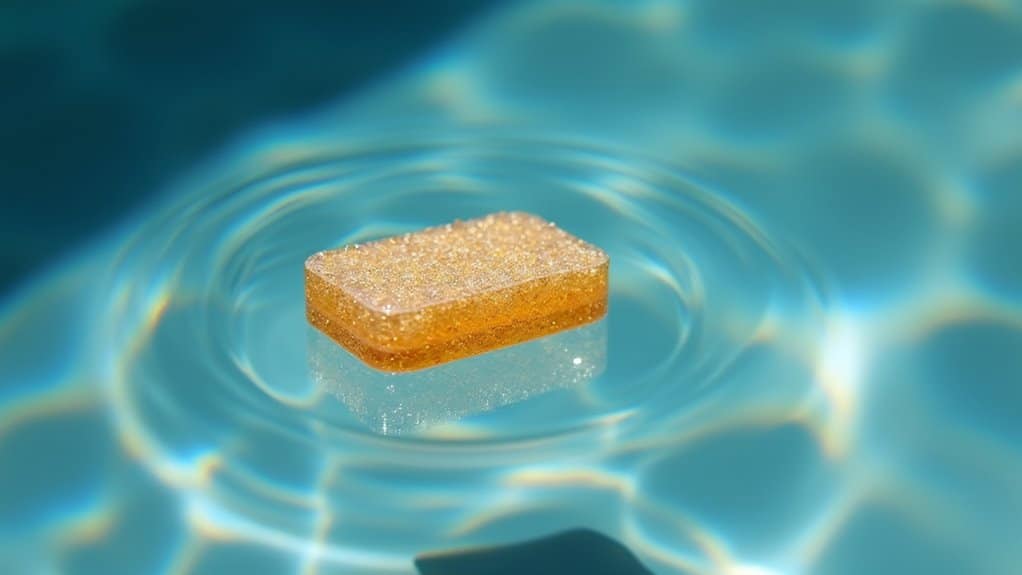
If you’re seeking a sanitizer that treats your vinyl liner more gently than chlorine while maintaining effective disinfection, bromine presents a compelling option. Unlike chlorine, bromine doesn’t bleach vinyl liners when you maintain proper concentration levels, making it safer for your pool investment.
Bromine’s oxidation reactions effectively eliminate bacteria, viruses, and organic contaminants across a wider pH range than chlorine-based systems. You’ll notice reduced eye irritation and skin sensitivity compared to chlorine exposure. For heated pools and hot tubs, bromine excels where chlorine degrades. Bromine comes in tablet and liquid forms, ensuring convenient application options for pool owners. Bromine tablets can be placed in automatic feeders that slowly dissolve the sanitizer into your water, maintaining consistent protection levels. Since bromine is sensitive to sunlight, outdoor pool owners should consider whether this sanitizer aligns with their specific setup and UV exposure conditions.
However, you must monitor alkalinity levels closely, as bromine erodes total alkalinity over time. Regarding sanitizer storage requirements, store bromine tablets in cool, dry conditions away from direct sunlight. Test your water regularly to maintain ideal sanitizer levels between 2-4 ppm for reliable pool protection.
Water Balance Chemicals Safe for Vinyl
Maintaining precise water chemistry requires you to carefully manage multiple chemical parameters beyond sanitization alone. You’ll need to balance alkalinity, hardness, and stabilizer levels to protect your vinyl liner from degradation and chemical damage.
| Parameter | Target Range | Adjuster | Risk if Low |
|---|---|---|---|
| Alkalinity | 100–150 ppm | Sodium bicarbonate | Corrosive water |
| Calcium Hardness | 150–400 ppm | Calcium chloride | Liner weakening |
| Cyanuric Acid | 30–75 ppm | Add separately | Reduced efficacy |
| pH | 7.2–7.6 | Adjust after alkalinity | Imbalanced chemistry |
You should adjust alkalinity before pH for stable results. For seasonal chemical needs, monitor hardness frequently during temperature fluctuations. When selecting specialty chemical compatibility products, verify vinyl liner approval with manufacturer guidelines before application to prevent localized bleaching or degradation. Never mix chemicals together, as you should add them separately and allow full circulation before introducing additional products to your pool. Improper balancing can affect the health of your vinyl liner and pool equipment, making it essential to maintain these parameters consistently. If you encounter access issues while researching chemical safety, such as HTTP 403 Forbidden errors, consult your server administrator or website provider to ensure you can access the complete pool maintenance information.
Managing Ph and Alkalinity Without Damage
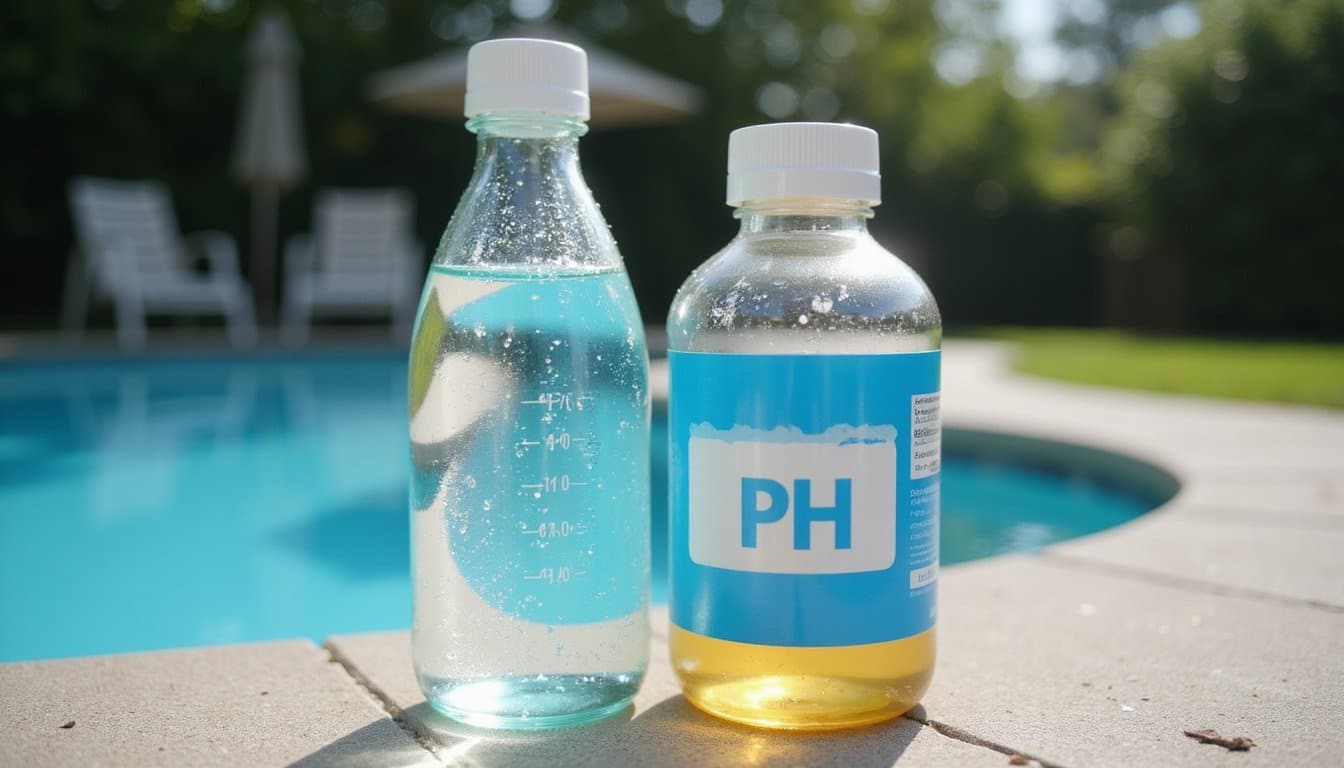
Because pH and alkalinity work interdependently to determine your pool’s chemical stability, you’ll need to understand how they interact to prevent liner damage. Target alkalinity initially, maintaining 80–120 ppm stabilizes pH fluctuations and protects vinyl liner longevity. Then fine-tune pH to 7.2–7.6 using appropriate adjusters.
Use muriatic acid or sodium bisulfate to decrease both values. Apply alkalinity increaser (sodium bicarbonate) to raise alkalinity alone. For pH-only adjustments, employ aeration after acid additions.
Dose chemicals gradually in small increments rather than single large applications, which shock your liner. Maintain circulation right away post-treatment for even distribution. Test frequently with reliable kits to verify results. Consult a local independent Latham Builder to ensure your chemical adjustments align with your pool’s specific needs. Remember that the Langelier Saturation Index is more critical than over-chlorination alone when protecting your vinyl liner from fading and deterioration. This methodical approach guarantees optimum pool water clarity while preserving your vinyl liner’s integrity and elasticity throughout its lifespan.
Algaecides and Clarifiers for Vinyl Pools
When you’re treating algae in your vinyl pool, you’ll want to prioritize non-metallic algaecides, particularly polyquat formulations, since they effectively eliminate algae without the staining risks that copper-based products can pose to your liner. You should pair these algaecides with polymer-based clarifiers that won’t interact chemically with vinyl or introduce harsh solvents that could degrade the material. Strict adherence to dosage instructions and running your filtration system immediately after application will prevent residue buildup and protect your liner’s integrity. Before applying any algaecide or clarifier treatment, ensure your pool water is properly balanced by testing and adjusting pH, Total Alkalinity, and Calcium Hardness to their appropriate levels, as this foundational step will maximize the effectiveness of your chemical treatments and maintain liner safety.
Non-Metal Algaecide Options
For vinyl pool owners, non-metal algaecides represent the safest chemical approach to algae control, as they eliminate the staining risk that copper-based products pose to your liner. You’ll find two primary options: quaternary ammonium (quat) algaecides and polymer-based algaecides (polyquats). Both work by breaking algae’s protective layer, enabling better chemical penetration.
Polyquats offer superior performance and are less prone to foaming than quats, making them ideal for vinyl applications. You should always select products specifically labeled “vinyl-liner safe” and “metal-free.” Implement a periodic testing schedule to monitor water chemistry, maintaining proper pH, alkalinity, and oxidation reduction potential guarantees effective algaecide performance. Follow manufacturer dosing instructions precisely; exceeding recommendations risks foaming and liner damage. Apply algaecides as part of routine maintenance or after shock treatments for resistant algae.
Clarifiers Safe for Liners
While algaecides target algae growth directly, clarifiers work through a distinct mechanism, they agglomerate fine particles suspended in water, allowing your filter to remove them more efficiently. For vinyl liners, you’ll want polymer-based clarifiers (polyquats) or natural chitosan-based options, both non-foaming and liner-compatible.
Prioritize non-metallic formulas for heavy metal removal concerns, as metal-based agents risk discoloration. Guarantee clarifiers are non-acidic to prevent etching or wrinkling. Avoid products containing colorants or dyes that may migrate into vinyl.
When applying, always pre-dilute before adding to your pool. Distribute slowly around the deep end perimeter while circulation runs to prevent chemical pooling against the liner. Follow label dosages precisely, overdosing causes sticky residue and calcium hardening buildup. Operate your filtration system afterward to remove agglomerated particles completely.
Recommended Chemical Levels and Ranges
Maintaining proper chemical levels in your vinyl liner pool requires careful monitoring and adjustment of five key parameters that work together to protect both your pool’s infrastructure and swimmers’ safety. You’ll need to keep pH between 7.2–7.6 PPM, free chlorine at 1.0–3.0 PPM, and total alkalinity at 100–150 PPM. For mineral balance requirements, maintain calcium hardness between 150–250 PPM and cyanuric acid at 25–100 PPM. These vinyl pool water maintenance parameters prevent scale formation, liner degradation, and bacterial growth. You should adjust alkalinity initially, then pH, ensuring each parameter reaches its target range before addressing others. Monthly shock treatments may become necessary, especially during hot weather. Regular testing enables you to make precise adjustments that safeguard your liner’s longevity.
Proper Chemical Application Techniques
Once you’ve established your target chemical levels, you’ll need to master the techniques that safely deliver those chemicals into your vinyl pool without causing damage to the liner. Start with proper chemical mixing techniques by pre-dissolving slow-acting sanitizers like calcium hypochlorite in a separate bucket before pool entry. Always add diluted chemicals around the deep end while your filter runs, never introducing concentrated granules directly. Chemical compatibility considerations are critical, never blend incompatible substances like sodium bicarbonate and calcium chloride. Incorporate chemicals individually, spacing applications according to product labels to allow full circulation between incorporations. Use only plastic buckets and soft-bristled tools, and filter pre-mixed solutions through a sieve to catch undissolved solids that could damage your liner.
Chemicals and Practices to Avoid
Understanding what *not* to do is just as pivotal as mastering proper chemical application; missteps in pool chemistry can rapidly compromise your vinyl liner’s integrity and longevity. Avoid undissolved granular chlorine, which causes bleaching and localized damage. Don’t use chlorine floaters or apply liquid chlorine unevenly, as concentrated spots create chemical burns. Never mix incompatible chemicals or use harsh solvents; these degrade vinyl materials. Prevent improper water circulation, which allows chemicals to settle and concentrate on surfaces. Don’t shock excessively or neglect pH and alkalinity balance; acidic water causes brittleness and fading. Environmental pollutants and nearby plant chemicals disrupt water stability, making vinyl brittle. Avoid covering pools immediately after chemical supplement, trapping high concentrations against the liner.
Frequently Asked Questions
How Often Should I Test My Vinyl Pool Water to Ensure Chemical Balance?
You should establish a routine testing schedule of 2–3 times weekly during swim season to maintain ideal testing frequency for your vinyl pool. You’ll test chlorine, pH, and alkalinity at these intervals. However, you must increase testing to daily during heavy use or extreme temperatures. You shouldn’t skip weekly checks during fall and winter, even if your pool’s covered. You’ll retest within 24 hours after chemical adjustments to verify corrections and prevent dosing errors.
Can I Mix Different Sanitizers Together, or Should I Use Only One Type?
You shouldn’t mix different sanitizers together. Instead, you’ll want to stick with one primary sanitizer system to maintain predictable water chemistry and protect your vinyl liner. Alternating chemical sanitizers without proper neutralization and flushing can cause dangerous reactions, toxic gas release, and equipment degradation. In the same way, guarantee proper chemical storage by keeping different sanitizers completely separate to prevent accidental cross-contamination. Always follow manufacturer guidelines strictly.
What’s the Best Time of Day to Add Chemicals to My Vinyl Pool?
You’ll achieve ideal results by adding chemicals during evening or nighttime hours rather than early morning hours or late afternoon hours. This timing minimizes UV-induced chlorine degradation, which can exceed 50% in daylight, and reduces liner bleaching risks. You should allow chemicals to circulate overnight for thorough dispersal, then retest water before swimming. Avoid daytime applications when concentrated chemical exposure and intense sunlight intensify liner degradation potential.
How Long Should I Wait Before Swimming After Adding Chemicals to the Pool?
You’ll typically wait 20–30 minutes for standard chemicals, but shock treatments require 8–24 hours until free chlorine drops to 1–3 ppm. Water temperature considerations matter, warmer pools disperse chemicals faster, while cooler water slows mixing. Sunlight exposure accelerates chlorine dissipation, potentially shortening wait times. However, don’t rely solely on elapsed time; always test chemical levels with a kit before swimming to confirm safety and proper dispersion.
Will High Cyanuric Acid Levels Permanently Damage My Vinyl Liner if Exceeded?
High cyanuric acid won’t permanently damage your vinyl liner if you act promptly. However, you’re risking permanent degradation if excessive CYA persists alongside low pH for extended periods. You’ll prevent irreversible damage by maintaining proper chemical storage, conducting seasonal chemical adjustments, and keeping CYA between 25–50 ppm. Wrinkling and stretching are reversible if you correct chemical imbalances quickly. Permanent deterioration occurs only with prolonged neglect of chemical balance.