
You’ll find vinyl pools cost $40,000–$75,000 upfront but require liner replacement every 8–12 years, while fiberglass pools ($55,000–$100,000) last 30+ years with minimal maintenance. Fiberglass installs in 2–4 weeks with limited design options, whereas vinyl accommodates custom layouts in 3–5 weeks. Fiberglass’s non-porous gel coat resists algae naturally and needs less chemical balancing; vinyl liners trap debris at seams and demand frequent cleaning. Each option presents distinct trade-offs worth exploring further.
Cost and Long-Term Value
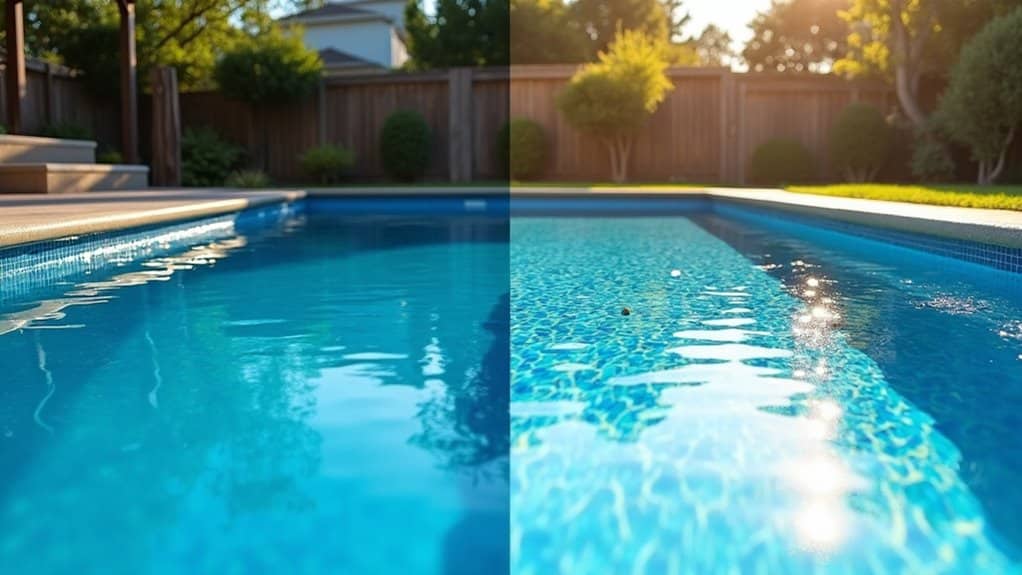
When you’re evaluating vinyl versus fiberglass pools, the initial price difference, typically $10,000–$15,000 favoring vinyl, can seem decisive, but it masks a more complex financial picture over the pool’s lifetime. Vinyl pools cost $40,000–$75,000 upfront, while fiberglass ranges $55,000–$100,000. However, you’ll face mandatory liner replacement every 8–12 years at $6,000–$7,500 per cycle, substantially eroding your savings advantage. Over a decade, you’ll spend approximately $17,500 extra on vinyl maintenance and liner replacement versus $10,000 for fiberglass upkeep. Fiberglass’s superior structural integrity and 30+ year overall life expectancy deliver greater long-term value. Though fiberglass requires higher initial investment, you’ll recoup those costs through dramatically reduced repairs, minimal maintenance, and stronger property resale value. Additionally, fiberglass pool installation can be completed in as little as 3 days, allowing you to enjoy your investment much sooner than vinyl alternatives. Fiberglass pools’ non-porous surface also eliminates the need for the frequent chemical balancing required by vinyl liners, further reducing long-term ownership expenses. Concrete pools, by contrast, require regular acid washing and resurfacing every 7–15 years, making them significantly more demanding than either vinyl or fiberglass alternatives. The true economy lies in durability, not opening purchase price.
Installation Speed and Design Flexibility
Because fiberglass pools arrive pre-manufactured, they’ll get you swimming swiftly faster than vinyl alternatives. Fiberglass installations typically complete in 2–4 weeks, while vinyl liner pools require 3–5 weeks or longer depending on complexity.
Fiberglass pools install in 2–4 weeks versus 3–5 weeks for vinyl, delivering faster swimming readiness through pre-manufactured construction.
Fiberglass’s speed advantage stems from its streamlined process:
- Pre-formed shells arrive ready for placement into prepared excavation
- Minimal on-site assembly reduces construction timelines markedly
- Quick plumbing and electrical connections follow shell positioning
- Negligible curing time enables rapid pool use
Premium fiberglass manufacturers often provide lifetime warranties that protect your investment and enhance customer confidence in the durability of their pools.
However, design flexibility favors vinyl liners extensively. You’ll appreciate vinyl’s customizable layouts that accommodate unique site constraints and irregular backyards. Vinyl construction allows custom shapes, depths, and integrated features like spas and benches. Fiberglass pools, conversely, restrict you to manufacturer-standard geometric designs with limited customization options beyond color and finish selections. In contrast, vinyl liner pools can be customized in shape, size, and depth to fit virtually any backyard configuration. Concrete pools require significant planning and groundwork to design but ultimately offer the most customization available among all pool types.
Maintenance Requirements and Surface Quality
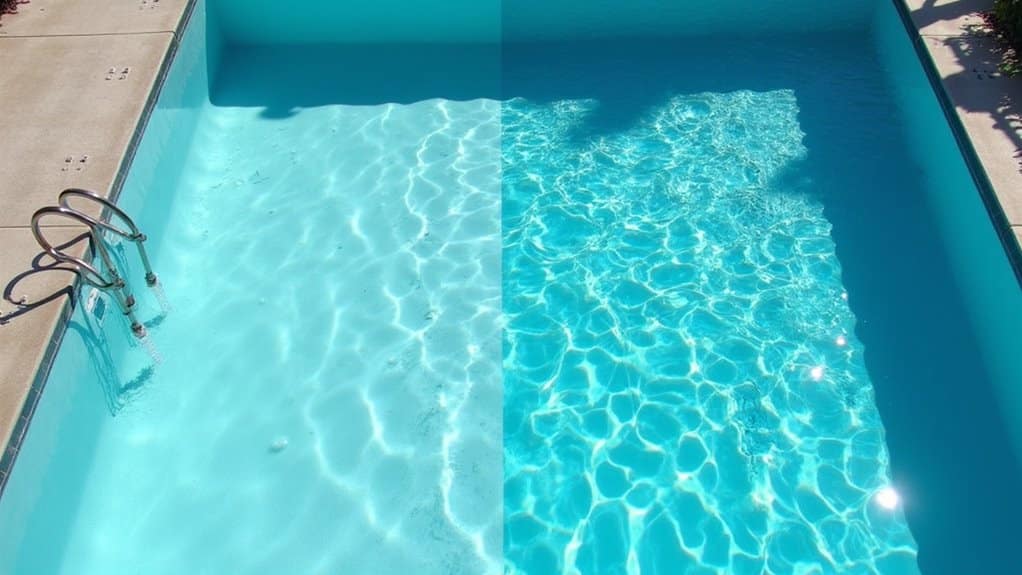
The maintenance demands and surface characteristics of your pool choice will considerably influence long-term satisfaction and operating costs. Fiberglass pools feature a smooth, non-porous gel coat that delivers superior algae resistance and requires minimal scrubbing. You’ll spend less time on chemical treatments since dirt and algae struggle to adhere to the seamless surface. Vinyl pools demand more frequent maintenance due to seams and liner texture that trap algae and debris. Your water chemistry sensitivity increases extensively with vinyl; imbalances directly threaten liner longevity and appearance. Both pools require regular pH and chlorine monitoring, but vinyl liners are far more vulnerable to staining and degradation from chemical fluctuations. For fiberglass pools, use pool-safe descaler to remove calcium deposits and maintain the glossy appearance of the gel coat. Fiberglass surfaces rarely need resurfacing, while vinyl liners require complete replacement every 5–12 years at substantial cost.
Frequently Asked Questions
How Long Do Fiberglass Pools and Vinyl Liners Typically Last?
You’ll find that fiberglass pools typically last 25–30 years, though well-maintained ones reach 40–50 years. Their expected lifespan vastly exceeds vinyl liners, which you’ll need to replace every 7–9 years. Your maintenance requirements differ considerably: fiberglass demands only routine cleaning and chemical balancing, while vinyl liners need careful handling to prevent tears. You’ll invest substantially more in long-term vinyl replacement costs despite lower upfront expenses.
Can Vinyl Pool Liners Be Customized With Different Colors and Patterns?
Yes, you can extensively customize vinyl pool liners with diverse colors and patterns. You’ll find custom design options ranging from mosaic tiles and geometric shapes to pebble textures and full-print seamless designs. Your personalized aesthetics choices include blues, greys, neutrals, and bold colors. You can also select textured finishes mimicking stone or pebbles for improved grip. Consider temperature effects: darker liners absorb heat, while lighter options reflect sunlight, optimizing your pool’s performance.
Which Pool Type Is More Resistant to Algae Growth?
You’ll find that fiberglass pools offer superior algae resistance compared to vinyl liners. Fiberglass’s smooth, non-porous gelcoat surface prevents algae from establishing itself effectively. You won’t need extensive chemical treatment since algae struggle to attach and proliferate. Vinyl pools, conversely, develop algae in seams and circulation-poor areas, requiring you to perform frequent brushing and more rigorous chemical treatment to maintain clarity and prevent outbreaks.
What Happens to Vinyl Pools if the Substructure Is Damaged?
If your vinyl pool’s substructure sustains damage, you’re facing serious consequences. Water infiltration occurs behind the liner, causing rust in metal panels or rot in wood supports. You’ll experience structural compromises including liner sagging, wrinkles, and separation from the walls. Eventually, you’ll need to drain the pool, access damaged panels, and replace both the liner and potentially the structural components themselves, a costly, labor-intensive undertaking that can escalate quickly.
Are Fiberglass Pools Susceptible to Cracking From Ground Movement?
Yes, your fiberglass pool can crack from ground movement, though most cracks are superficial gelcoat damage. You’ll face the greatest risk when soil expansion occurs beneath an improperly leveled shell. You can minimize this by maintaining consistent hydrostatic pressure through proper water levels and using quality backfill materials like crushed stone. You should also confirm professional installation with adequate base compaction, as poor site preparation considerably increases your vulnerability to movement-related cracking.