
Fiberglass pools can boost your home’s value by 7-10% while offering significant long-term savings through reduced maintenance costs of $600-$1,200 annually. You’ll benefit from a durable 25-30 year lifespan, quick 2-6 week installation, and enhanced aesthetic appeal with modern design options. Their non-porous surfaces resist algae and staining, requiring fewer chemicals and less upkeep. Market projections and regional factors reveal additional compelling reasons to contemplate this investment.
Understanding the Financial Impact on Property Value
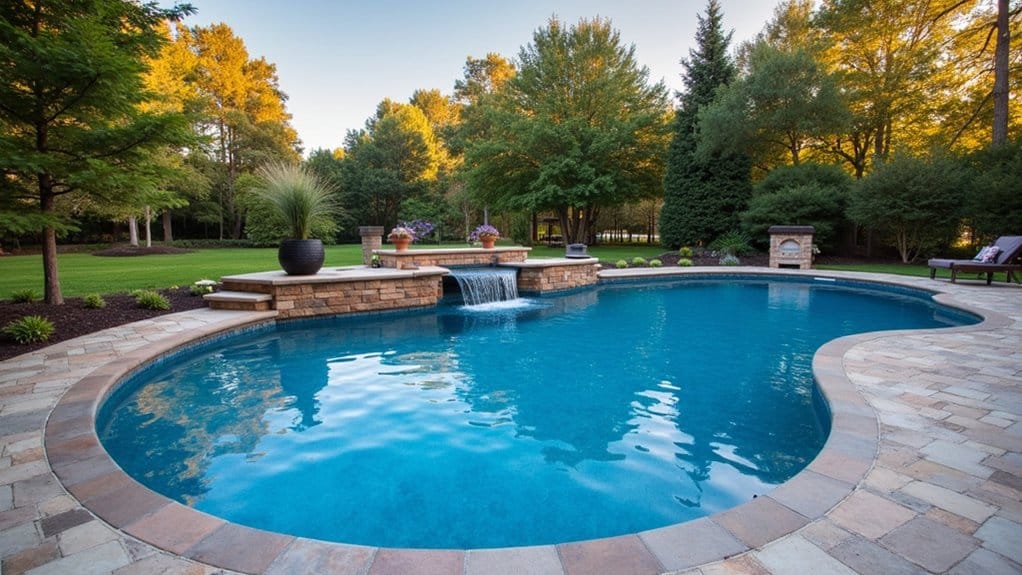
Property valuation data reveals that adding a fiberglass pool can greatly boost your home’s market worth, with typical increases averaging 7% nationwide. Your location notably impacts the return on pool financing, with warm-climate regions like Los Angeles seeing up to 10% value increases, translating to $95,000 in added worth. Maintenance costs can accumulate to several thousand dollars annually.
You’ll find the highest returns in areas where pools are scarce, as uniqueness drives demand. However, climate plays a vital role – year-round usability in states like Florida and Texas aligns perfectly with buyer demographics, while seasonal regions like Wisconsin see minimal gains. Initial costs between $45,000 to $85,000 for fiberglass pool installation must be carefully weighed against potential value increases. The quick installation time of fiberglass pools means you can start enjoying your investment sooner compared to other pool types. Consider your neighborhood’s characteristics too; areas with young families often value pools more highly. The scale of your home matters as well, as percentage increases yield different absolute values for median versus luxury properties.
Long-Term Cost Analysis and ROI Considerations
When you compare fiberglass pools to traditional options, you’ll find significant maintenance savings of $600-$1,200 annually due to reduced chemical needs and fewer structural repairs. Your investment’s value compounds over time through the elimination of costly liner replacements and the minimal need for resurfacing, which plague vinyl and concrete pools respectively. The 25-30 year lifespan of a fiberglass pool, coupled with its energy-efficient insulation properties and lower operational costs, creates a substantial return on investment despite the higher initial price point of $25,065 to $48,995. The non-porous surface of fiberglass pools significantly reduces the need for chemical treatments and frequent maintenance, making them a more economical choice for long-term pool ownership. The quick installation process of fiberglass pools means homeowners can start enjoying their investment within weeks rather than months compared to concrete alternatives. For security purposes, many pool websites implement access restrictions to protect their pricing and product information from potential online threats.
Maintenance Vs Traditional Pools
Understanding the long-term cost implications between fiberglass and traditional pools reveals compelling financial advantages for fiberglass installations. You’ll find significant savings in chemical costs and cleaning frequency, as non-porous surfaces resist algae growth and require fewer treatments. While installation costs may be higher initially, the surface durability of fiberglass minimizes repair frequency compared to concrete or vinyl options. Quality craftsmanship in modern fiberglass pools contributes to exceptional longevity and reliability. The quick installation time makes fiberglass pools a more convenient choice for homeowners eager to start enjoying their investment.
Regular professional maintenance checks help identify and address potential issues early, preventing costly repairs down the line. Energy efficiency becomes apparent through better heat retention and reduced pump requirements, cutting operational expenses by 30-50%. The stain-resistant properties eliminate the need for costly re-plastering, and proper maintenance practices extend the pool’s lifespan beyond 30 years. You won’t face the $10,000-$15,000 resurfacing costs common with concrete pools, making fiberglass a more economical choice when considering lifetime ownership expenses.
Value Over Time Analysis
The long-term value analysis of fiberglass pools reveals compelling financial benefits that extend far beyond initial installation costs. You’ll find significant cost savings through reduced maintenance and longer investment longevity compared to traditional pool options. The quick installation time means you can start enjoying your investment within weeks rather than months. While the initial investment ranges from $25,065 to $48,995, you’ll recover costs through minimal repair requirements and reduced chemical consumption. The non-porous surface eliminates the need for expensive resurfacing, commonly required with gunite pools. Your property value will likely increase due to the pool’s premium appeal and low-maintenance characteristics, making it an attractive feature for future buyers.
| Cost Factor | Fiberglass vs Traditional |
|---|---|
| Lifespan | 25-50 years vs 10-20 years |
| Annual Maintenance | $600-1,200 vs $2,000-4,000 |
| Resurfacing Needs | None vs Every 10-15 years |
| Chemical Usage | Lower vs Higher |
Design Features and Aesthetic Benefits
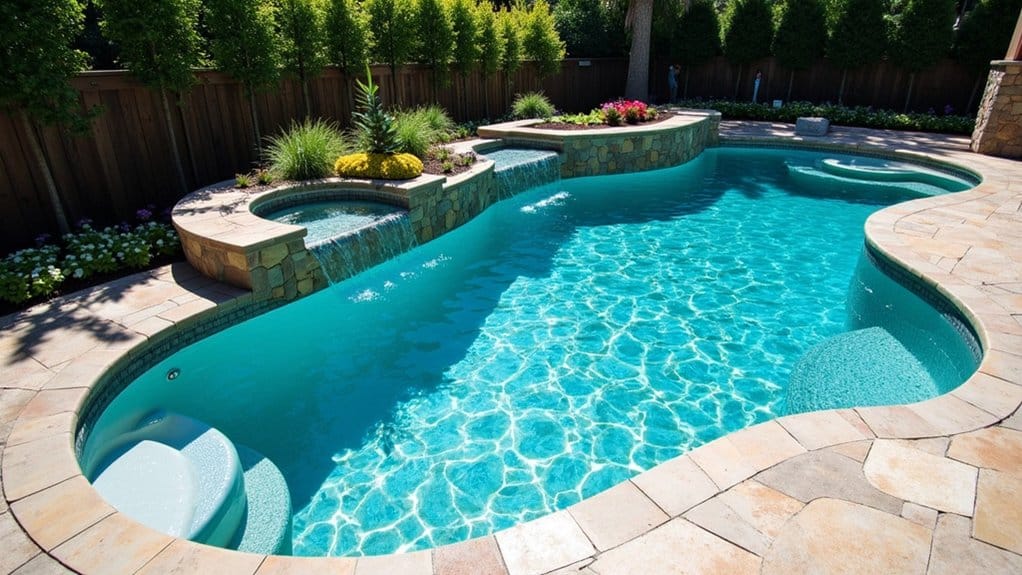
Modern fiberglass pools deliver unparalleled aesthetic versatility through their factory-manufactured gelcoat surfaces and customizable designs. You’ll benefit from extensive color customization options, ranging from classic neutrals to vibrant finishes that resist UV damage and chemical wear. The non-porous gelcoat surface maintains its aesthetic appeal while preventing algae growth and staining. Tanning ledges and spas can be seamlessly incorporated into your pool design to enhance functionality and visual appeal. These cutting-edge pools offer rapid installation times, often completing the entire process within just a few days. National regulations restrict pool width to 16 feet maximum for transportation purposes.
Your pool’s design versatility extends to modern styles with seamless integration into any landscape. Custom dimensions accommodate various property sizes, while pre-designed shapes offer contemporary and geometric options. Safety features include non-slip surfaces and intuitive layouts with gentle entry points. The eco-friendly design supports saltwater systems, ensuring crystal-clear water that enhances your pool’s appearance. These factory-applied finishes require minimal maintenance, preserving their pristine look for decades.
Installation Process and Timeline Advantages
When comparing installation timelines across pool types, fiberglass pools offer significant advantages through their streamlined 2-6 week completion process. The installation efficiency stems from factory-made shells that arrive ready for placement, eliminating lengthy on-site construction delays typical of concrete pools. Professional installation ensures the most reliable results for long-term durability and proper functionality. Adding a fiberglass pool is a highly attractive option as it requires minimal maintenance compared to other pool types. Proper site preparation requires establishing a clear access path to accommodate excavation equipment and machinery.
Your timeline flexibility begins with permit acquisition, taking 1-3 weeks, followed by rapid excavation that’s completed in just 1-2 days for most sites. The shell placement and backfilling process typically requires only 3-4 days, while plumbing and electrical work takes about a week. You’ll find this process particularly advantageous compared to concrete pools, which often require 2-3 months for completion. Even with potential weather delays or site challenges, fiberglass installations maintain their efficiency through well-planned, phased workflows.
Maintenance Requirements and Durability Factors
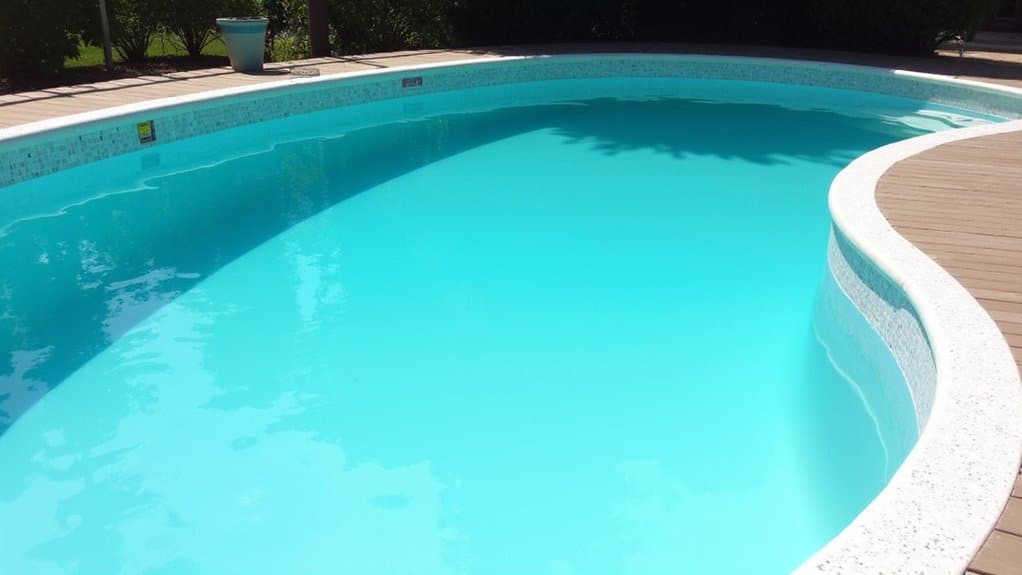
Beyond efficient installation, fiberglass pools stand out for their remarkably low maintenance demands and exceptional durability characteristics. You’ll benefit from maintenance efficiency through simple weekly tasks like surface brushing and water chemistry checks, while daily skimming keeps your pool pristine. The non-porous surface greatly reduces chemical consumption and resists algae growth, leading to annual savings of $500-$1,500 in professional cleaning costs.
In durability comparison to concrete pools, fiberglass pools excel with their flexible construction that withstands ground movement and natural insulation properties that decrease energy costs. You won’t need frequent replastering or acid washes, and with proper care, your pool can last over 30 years. The only major maintenance is resurfacing every 10-15 years, making fiberglass pools a sustainable, long-term investment.
Regional Considerations and Market Trends
When you’re evaluating a fiberglass pool investment, you’ll find significant value variations across regions, with North American and European markets showing higher returns due to established infrastructure and premium pricing. Your pool’s climate-adjusted return potential depends heavily on your location, as regions with longer swimming seasons and higher disposable incomes, particularly in emerging Asia-Pacific markets, demonstrate stronger growth trajectories. Market data indicates you’ll see the strongest investment potential in areas where urbanization and tourism development intersect, with a projected CAGR of 4% through 2033 driving sustained value appreciation.
Geographic Value Variations
Although fiberglass pool values fluctuate greatly across different regions, understanding these geographic variations is essential for making informed investment decisions. Geographic pricing depends heavily on your location’s market dynamics and infrastructure development.
Consider these key regional value factors:
- North America and Europe command premium prices due to established demand and sophisticated installation networks
- Asia-Pacific markets offer more competitive pricing but may have limited customization options
- South American regions present varying costs based on urbanization levels and infrastructure availability
- Emerging markets typically feature lower installation costs but may have fewer premium features available
You’ll find regional demand considerably impacts your pool’s long-term value, with areas experiencing rapid urbanization and rising disposable incomes showing stronger appreciation potential. Local regulations, climate considerations, and material availability in your region will directly influence your investment returns.
Climate Impact on Returns
Understanding how climate affects your fiberglass pool’s return on investment requires analyzing both regional weather patterns and market dynamics. The pool’s climate resilience directly impacts investment longevity and property value appreciation.
| Climate Zone | Investment Impact |
|---|---|
| Cold Regions | Higher ROI due to freeze-thaw resistance and rapid heating |
| Coastal Areas | Premium returns from salt resistance and durability |
| Hot Climates | Value boost from low maintenance and cooling efficiency |
| Variable Weather | Enhanced appreciation from adaptation capabilities |
You’ll find stronger returns in regions where traditional pools struggle with environmental challenges. For example, in areas with extreme temperature fluctuations, fiberglass pools’ flexibility and thermal response capabilities translate to reduced maintenance costs and extended seasonal use, ultimately boosting your property’s market appeal and long-term value.
Market Growth by Region
While global markets exhibit varying adoption rates, the fiberglass pool industry demonstrates robust growth across key regions, with a projected CAGR of 6.5% from 2024 to 2033. Understanding regional market dynamics can help you make informed investment decisions in this expanding sector.
Key regional growth indicators include:
- North American trends show a 25% surge in pool construction, with the market expected to reach USD 5.7B by 2033
- European preferences emphasize sustainability and regulatory compliance, particularly in Germany, UK, and France
- Asia Pacific dynamics reflect rapid urbanization and middle-class growth, driving demand in China, India, and Japan
- Middle East developments focus on tourism infrastructure, with luxury resorts choosing fiberglass for durability in arid climates
Your investment potential aligns with these regional growth patterns, supported by technological advances and increasing eco-consciousness.
Frequently Asked Questions
Can Fiberglass Pools Be Removed if I Decide to Sell Later?
Yes, you can remove your fiberglass pool, but it requires a complete removal process – partial removal isn’t an option due to structural safety requirements. You’ll need professional demolition services, costing between $5,000-$15,000. While pools can increase your home’s resale value by over 5%, removal might be necessary if your target buyers prefer pool-free properties. Remember that the shell’s condition affects removal costs, with broken sections being more expensive to extract.
How Deep Can Fiberglass Pools Be Manufactured?
You’ll find that fiberglass pool depths typically range from 3.5′ to 8′ deep, depending on the manufacturing options and size. For smaller pools (under 27′), you’re looking at maximum depths of 5.5′. Medium-sized pools (27′-35′) can reach 6.5′, while larger pools (35’+) can achieve 8′ depths. However, if you’re considering a diving pool, you’ll need that full 8′ depth and must account for specific shift areas in the design.
Do Fiberglass Pools Affect Home Insurance Rates?
Yes, fiberglass pools will affect your home insurance premiums due to increased risk factors. You’ll need higher liability coverage since pools are considered “attractive nuisances.” However, you can minimize premium increases by installing safety features like fencing, covers, and alarms. Your location also impacts costs areas where pools are common typically see smaller premium increases ($50-$75 annually), while regions with fewer pools may face steeper rate hikes.
Can Existing Concrete Pools Be Converted to Fiberglass?
Yes, you can convert your concrete pool to fiberglass through a specialized conversion process. The transformation requires draining the pool, repairing cracks, removing existing liners, and applying vinyl ester resin (100-120 mils thick) before adding the fiberglass layer. While the cost comparison shows it’s more expensive than basic concrete repairs, it’s still cheaper than installing a new fiberglass shell. The conversion typically takes 7-14 days to complete.
What Happens to Fiberglass Pools During Earthquakes or Natural Disasters?
Your fiberglass pool’s earthquake resilience is exceptional due to its flexible structure. During seismic events, it’ll absorb ground movements without cracking, unlike rigid concrete pools. The lightweight design and seamless construction help prevent collapse under soil pressure shifts. For natural disaster preparedness, you’ll benefit from the pool’s ability to resist telluric movements and maintain structural integrity. The glass-and-epoxy composition withstands environmental stressors while resisting deformation during ground displacement.