
Over five years, you’ll spend roughly $3,250, $7,150 on saltwater versus $4,750, $6,750 on chlorine, landing within about $2,000 of each other. Saltwater front-loads a $1,000, $3,000 salt chlorinator, then trims annual consumables to $70, $300 for salt and supplemental chemicals. Chlorine undercuts installation but stacks $175, $900 yearly in sanitizer and stabilizer. Factor in one $300, $800 salt cell replacement, and the gap narrows further. The variables driving your specific total deserve a closer look.
Key Takeaways
- Saltwater costs more upfront due to the $1,000, $3,000 salt chlorinator system, while chlorine offers cheaper installation.
- Saltwater’s annual consumables run $70, $300, far below chlorine’s $175, $900 for sanitizer and stabilizer.
- Salt cell replacement every 3 to 7 years costs $300, $800, narrowing saltwater’s long-term savings advantage.
- Five-year operating totals are comparable: saltwater $3,250, $7,150 versus chlorine $4,750, $6,750.
- Total costs for both systems typically converge over a 5-to-7-year horizon despite different front-end prices.
How do salt water and chlorine pool maintenance costs compare
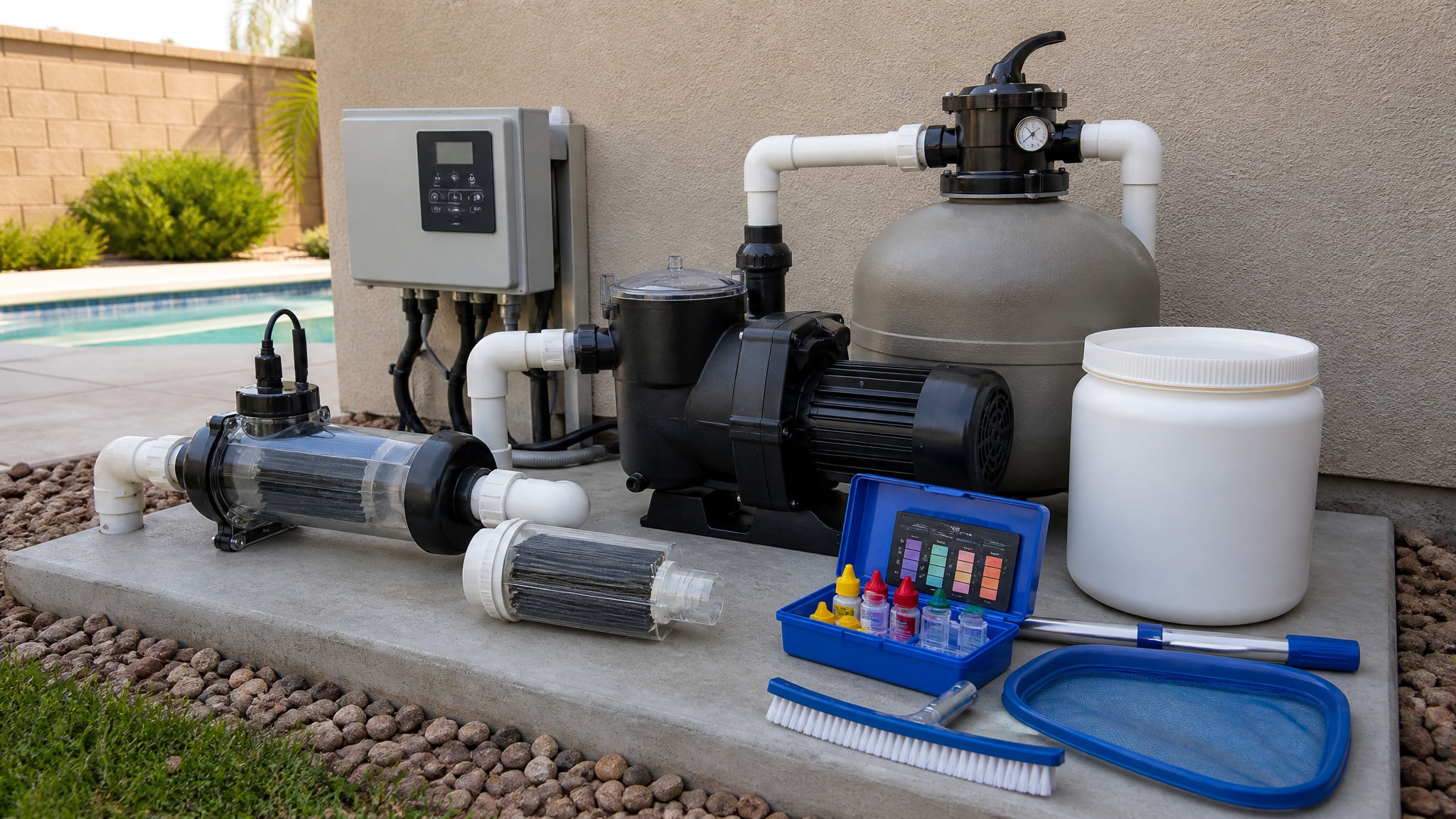
Salt water and chlorine pool maintenance costs typically converge on comparable total cost over 5 to 7 years, but they follow two different spending profiles. Saltwater systems front-load your investment with a chlorinator or generator, but they lower your recurring operating cost. You’ll spend roughly $70 to $300 annually on salt and supplemental chemicals, versus $175 to $900 for chlorine sanitizer and stabilizer. The tradeoff sits in equipment: your salt cell needs replacement every 3 to 7 years at $300 to $800, sometimes exceeding $900. Chlorine pools skip that specialty component, keeping sanitation hardware costs lower while demanding more frequent chemical purchases and testing. So saltwater shifts your budget toward equipment replacement, while chlorine concentrates it on ongoing chemicals.
What are the upfront costs of each type
Upfront costs depend on one main variable: whether you’re paying for a salt chlorinator system. That salt cell generator adds a distinct line item, typically running $1,000 to $3,000 for the unit and installation, plus its electricity connection for continuous chlorine production.
For inground builds, you’re looking at $29,000 to $100,000 saltwater versus $25,000 to $100,000 for traditional chlorine. Above-ground systems widen the gap proportionally: $3,000 to $8,000 saltwater against $1,600 to $7,500 chlorine.
Chlorine setups skip the generator entirely, so you avoid that hardware expense and its electrical draw. That’s why chlorine pools consistently carry the lower front-end price. You’re effectively trading a higher initial capital outlay for the salt system’s reduced recurring chemical demands downstream.
What ongoing costs should you expect
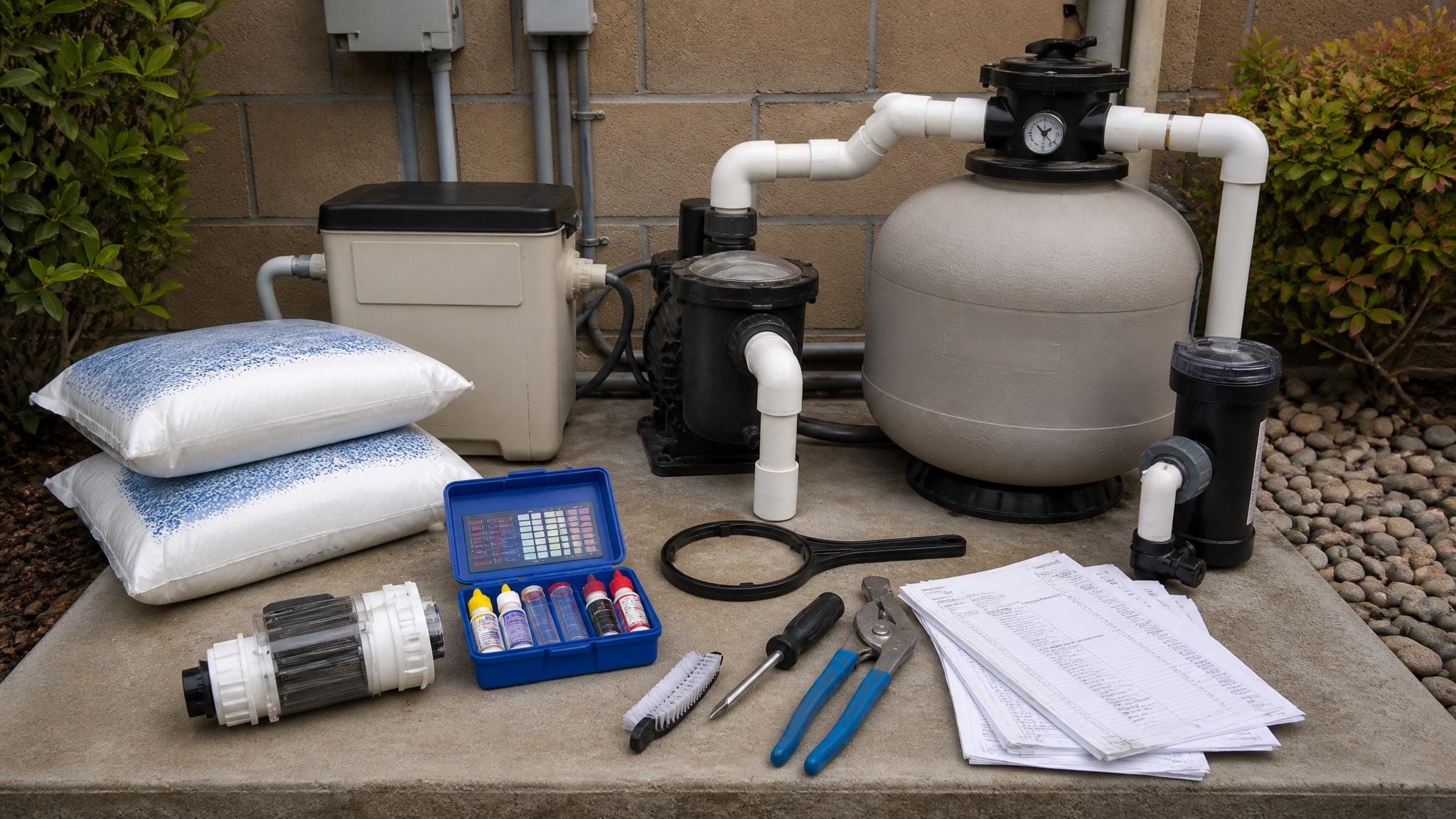
Ongoing costs for a saltwater pool favor it on a per-year basis. You’ll spend roughly $70 to $300 annually on salt and supplemental chemicals, versus $175 to $900 for chlorine sanitizer and stabilizer. Salt itself runs cheap, $10 to $20 per 40-pound bag, or about $90 to $180 for an 18,000-gallon pool. How to convert a pool to salt water can be an invaluable guide for homeowners considering the transition. Understanding the process and benefits can greatly enhance your pool experience.
But you can’t ignore the salt cell. Plan on replacing it every 3 to 7 years at $300 to $1,000, depending on your generator model and water chemistry. Factor in generator, pump, and filter servicing too.
Professional maintenance runs $80 to $150 monthly for chlorine, and salt service can cost $20 to $50 more per month, offsetting some of those chemical savings you’d otherwise bank.
How do the total costs stack up side by side
Side by side, the two systems land at comparable 5-year totals despite different sticker prices. You’ll pay more upfront for saltwater’s chlorinator, but you’ll recover ground through lower annual consumables. Chlorine flips that equation, undercutting installation while accumulating sanitizer and stabilizer costs.
| Cost Factor | Saltwater | Chlorine |
|---|---|---|
| Generator/Cell Setup | $1,000, $3,000 | $0 |
| Annual Chemicals | $70, $300 | $175, $900 |
| Cell Replacement (3 to 7 yr) | $300, $1,000 | N/A |
| 5-Year Operating Total | $3,250, $7,150 | $4,750, $6,750 |
Notice the overlapping ranges. After you factor in one salt-cell replacement, saltwater’s operating advantage narrows against chlorine’s recurring sanitizer spend. Your pool volume, service market, and cell longevity determine where you land. For most 20,000-gallon installations, you’ll see comparable totals by year five or seven.
How does each system affect long term upkeep
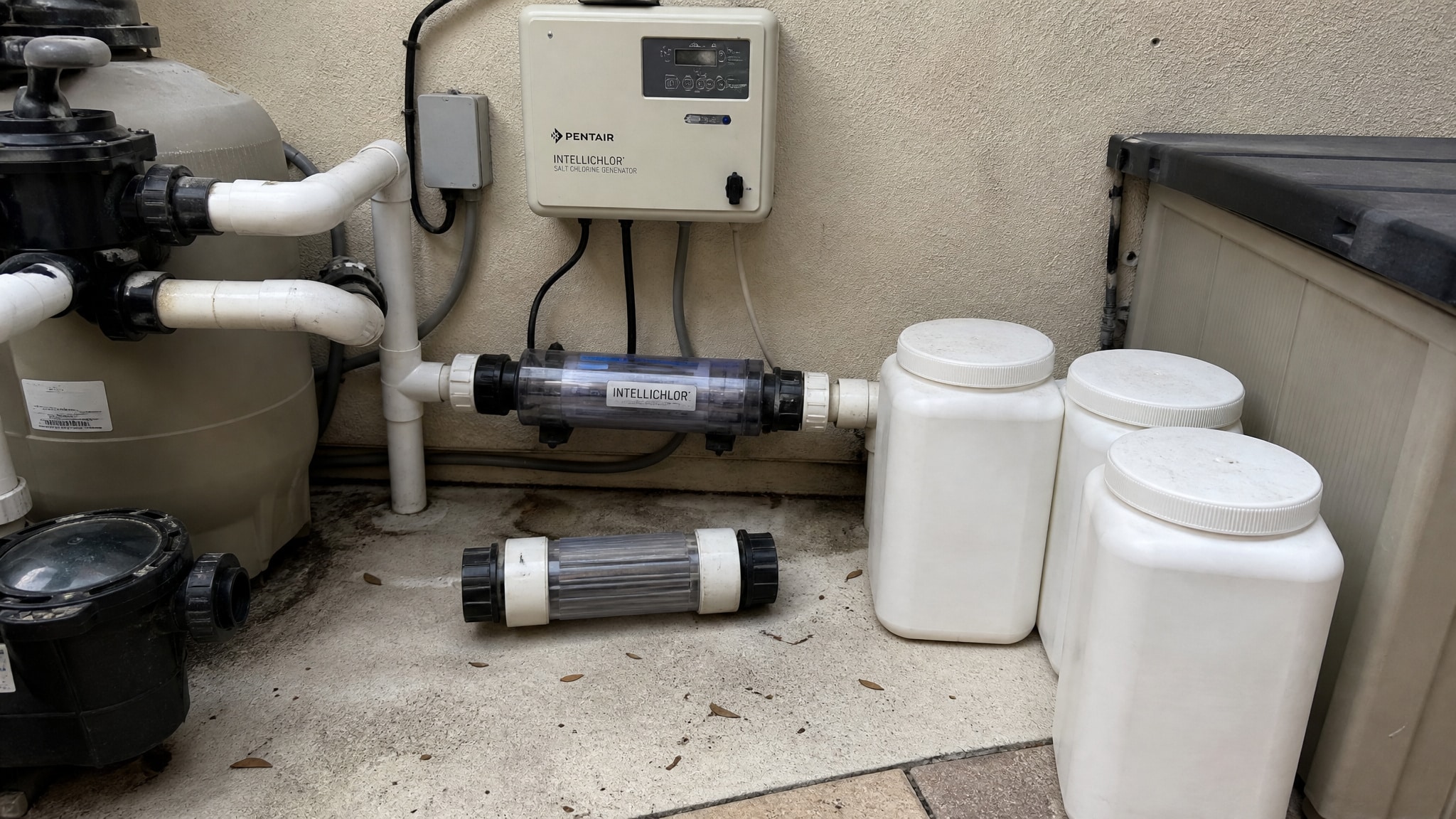
Each system reshapes your recurring maintenance obligations in distinct ways. With a saltwater system, you’ll shift spending toward equipment upkeep. Your salt cell needs replacement every 3 to 7 years at $300 to $800, sometimes $1,000, and you’ll clean the cell routinely to prevent calcium scaling. Your generator, pump, and filter also demand ongoing service attention. Annual chemical and salt costs stay low, roughly $70 to $300.
With a chlorine pool, you’ll avoid specialty sanitation components, so equipment replacement stays cheaper. But you’ll purchase sanitizer and stabilizer continuously, spending $175 to $900 yearly, and test water more frequently. Operationally, chlorine’s simpler, yet the recurring purchases add up. Over 5 to 7 years, both systems typically converge on comparable total upkeep. Maintaining free chlorine in a salt water pool can lead to more consistent water quality. This stability reduces the likelihood of algae growth and keeps the water sparkling clear.
How do you choose the more cost effective option
The more cost-effective option depends on your ownership timeline. If you plan to keep the pool fewer than five years, a chlorine system’s lower front-end price, $25,000 to $100,000 inground, minus the $1,000 to $3,000 salt chlorinator, wins. Beyond five to seven years, saltwater’s reduced consumable spend ($70 to $300 annually versus $175 to $900) offsets the higher installation and eventual salt cell replacement ($300 to $1,000 every 3 to 7 years). Factor pool volume, local service rates, and whether you’ll handle water-balance testing yourself. Calculate your five-year total: chlorine runs $4,750 to $6,750, saltwater $3,250 to $7,150 including one cell swap. Match those projections against your maintenance tolerance, recurring sanitizer purchases versus periodic equipment replacement, and select the system fitting your operational preference.
Conclusion: Weighing Salt Water Against Chlorine Costs
Salt water and traditional chlorine pools both keep water clean, but they differ on cost and upkeep. Salt systems cost more upfront for the generator but less on chemicals day to day, with the salt cell being the main long-term expense. Chlorine pools are cheaper to set up but need more hands-on chemical management. The right choice comes down to your budget, how hands-off you want maintenance to be, and how the water feels to you. How a salt water pool works involves a system that uses salt to generate chlorine through electrolysis. This process helps maintain clean water while reducing the harshness commonly associated with traditional chlorine pools.
Convert Your Pool to Effortless Saltwater
Switching to saltwater brings a smoother swim experience and lower long-term maintenance. At Pool Doctor of the Palm Beaches in Delray Beach, FL, our experienced team provides trusted Concierge Pool Maintenance with expert conversion and ongoing saltwater care. Call +1 (561) 586-2815 today and enjoy your pool worry-free.
Frequently Asked Questions
Is Salt Water Gentler on Skin, Hair, and Swimwear Than Chlorine?
Many people find salt water gentler, since it keeps chlorine at a low, steady level rather than the higher doses of a manually chlorinated pool, so there is less of the harsh smell, dryness, and eye sting. Swimwear and hair may fare a little better too. Both are safe, but salt water often feels softer.
Can You Convert an Existing Chlorine Pool to Salt Water?
Yes, and it is a common upgrade. Converting mainly involves adding a salt chlorine generator and adding salt to the water, since the pool itself usually needs no change. A pool professional can size and install the generator. Most standard pools convert without much trouble.
Does Salt Water Damage Pool Liners, Ladders, or Nearby Landscaping?
Salt is mildly corrosive over time and can affect some metal fixtures and, in high concentrations, nearby plants if splashed frequently. Modern pools use corrosion-resistant materials, and liners handle salt well. Rinsing metal parts and being mindful of runoff protects fixtures and landscaping, so problems are usually minor with good care.
Which System Is Better for People With Allergies or Sensitivities?
Salt water is often preferred by people with sensitivities, since the lower, steadier chlorine level tends to cause less irritation to skin and eyes. It still sanitizes with chlorine, just gently. Anyone with specific sensitivities should check with their doctor, but many find a salt pool more comfortable to swim in.
How Often Should You Test Water in Each Pool Type?
Both types should be tested a few times a week during swim season, and more after heavy use or storms. Salt pools also need occasional checks of salt level and the cell, while chlorine pools need closer attention to chlorine dosing. Regular testing keeps either type balanced and comfortable.